From Legacy to Cloud-Native: What KubeVirt Version 1.10.0 Represents for Modern Infrastructure
The enterprise infrastructure market is undergoing one of its most significant transformations in decades. Driven by an urgent need for flexibility, cost optimization, and an unrestricted search for alternatives to traditional hypervisor licensing models, organizations are re-evaluating how they manage their technology estates.
In this landscape, traditional virtualization and the container ecosystem are no longer parallel worlds. Today’s major turning point is unification: managing virtual machines (VMs) and microservices under the same architectural umbrella. It is precisely here that KubeVirt establishes itself as the definitive technology for the future of data centers.
Be sure to read another analysis I wrote about “The Achilles Heel of KubeVirt”
What is KubeVirt?
For those who still view Kubernetes merely as a container orchestrator, KubeVirt redefines that boundary. It extends Kubernetes by adding hypervisor capabilities (via KVM/QEMU) directly to clusters, allowing virtual machines to run side-by-side with containers, natively treated as platform objects (Pods).
In practice, this means your VM gains superpowers: it inherits Kubernetes’ security ecosystem (RBAC), integrated monitoring, declarative automation, and advanced networking, unifying the management of legacy and modern workloads onto a single platform.
Furthermore, a decisive factor for corporate governance is that KubeVirt is a CNCF (Cloud Native Computing Foundation) graduated project—the highest stage of maturity and stability within the foundation, holding the exact same status as Kubernetes itself. For managers and architects, this endorsement provides fundamental guarantees:
- Neutrality and Open Governance: The project belongs to a neutral foundation rather than a single vendor, eliminating the risks of abusive licensing changes (vendor lock-in).
- Proven Maturity: “Graduated” status requires a robust ecosystem, rigorous security audits, and widespread adoption in global enterprise production environments.
- Long-Term Security: Ensures that the investment in the platform is enduring, backed by a vibrant community and continuous support from technology giants.
The Current Virtualization Market Landscape
Today’s market is guided by three non-negotiable pillars for middle and senior management:
- Escaping Lock-in: Organizations are seeking to break free from established hypervisor vendors that have significantly increased the cost of their licensing models.
- Operational Convergence: Maintaining separate silos (one team for VMs and another for Kubernetes) generates high operational overhead and slows down delivery.
- Innovation Platform: Infrastructure must serve as a foundation for future initiatives (such as AI and hybrid architectures) without abandoning the legacy systems that sustain current operations.
It is within this mature context that the open-source community is delivering crucial technological milestones.
KubeVirt v1.10.0: Major Breakthroughs for the Enterprise World
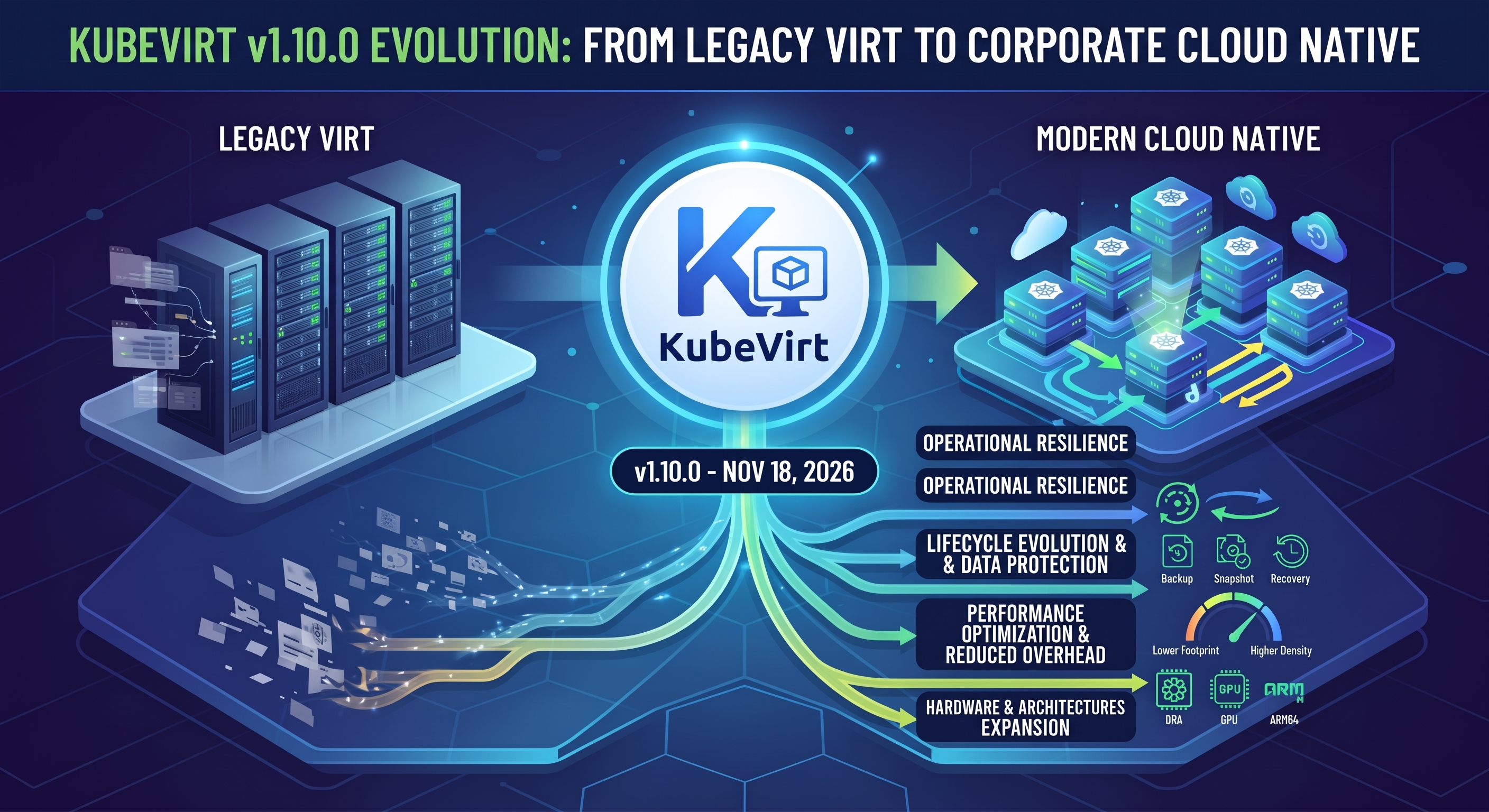
Officially released on November 18, 2026, KubeVirt v1.10.0 marks a turning point in the tool’s maturity, introducing deep improvements in resilience, security, and operational efficiency tailored for highly demanding enterprise environments.
Below, I highlight the most impactful advancements in this release for those designing enterprise architectures:
1. Operational Resilience and Safer Migrations
Infrastructure upgrades in production environments are often the Achilles’ heel of any operation. In v1.10.0, the live migration engine received critical structural improvements to prevent migrations from stalling during rolling upgrades across nodes running mixed component versions (virt-handler). For IT managers, this translates into more predictable maintenance windows and a lower risk of downtime during routine cluster updates.
2. Lifecycle Evolution and Data Protection (Backup)
Data protection and management have taken major leaps forward. This release promotes vital capabilities for the enterprise backup ecosystem:
- Support for offline incremental backups and the graduation to Beta of Incremental Backup features drastically optimize the RPO (Recovery Point Objective) for large data volumes.
- The handling of memory dumps and snapshots has been refined, decoupling the excessive consumption of utility PVCs and ensuring much cleaner, faster recoveries following unexpected
virt-launcherfailures.
3. Performance Optimization and Overhead Reduction
In large-scale enterprise environments, every megabyte of memory counts. Version 1.10.0 rewrote internal components—such as rewriting virt-launcher-monitor in C—reducing the memory footprint of the supporting infrastructure to roughly 2Mi per instance. Fewer resources consumed by the control plane mean higher usable VM density per node and, consequently, better hardware utilization (optimized TCO).
4. Hardware Expansion and Advanced Architectures (DRA and ARM64)
The pursuit of efficiency relies on leveraging specialized hardware. The Dynamic Resource Allocation (DRA) framework advanced significantly into Beta, improving how complex hardware devices (such as GPUs and SR-IOV accelerators) are allocated and monitored within virtual instances. Additionally, support for alternative architectures, such as advanced security features (UEFI Secure Boot) in ARM64 environments, paves the way for highly heterogeneous and modern infrastructure strategies.
Who Sustains and Evolves KubeVirt? (The Ecosystem Behind the Code)
A legitimate question from middle and senior management when evaluating open-source technologies is: who ensures continuity, rapid vulnerability patching, and product evolution?
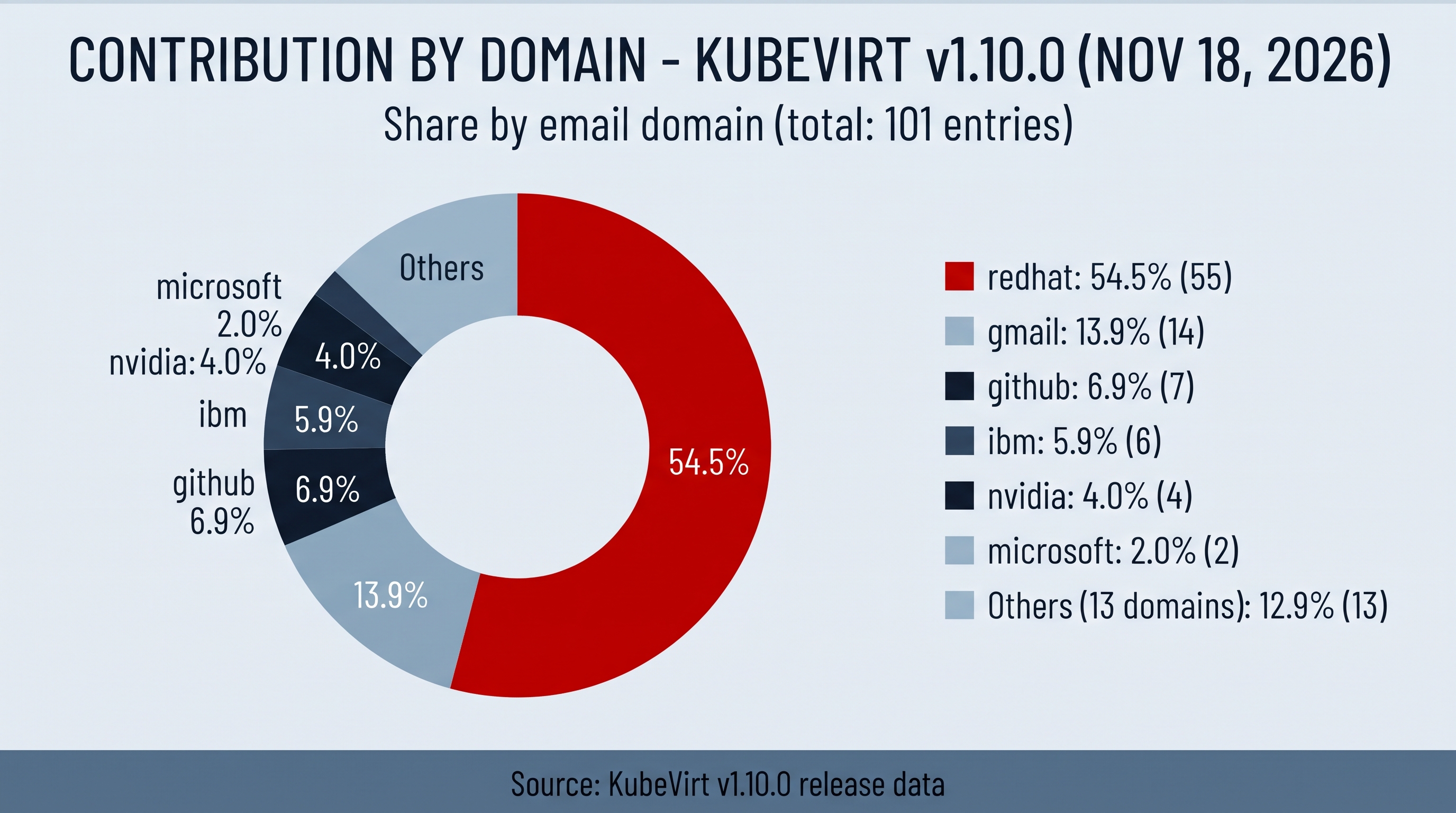
The numbers from the v1.10.0 release answer this question clearly. Far from being a project maintained solely by sporadic volunteer efforts, KubeVirt is driven by cutting-edge corporate engineering. An analysis of the contributions in this release reveals a deeply committed ecosystem, where technology giants lead both in the volume of dedicated specialists and in the actual delivery of source code enhancements.
This industrial backing ensures that the platform’s roadmap remains directly aligned with the real-world security, performance, and stability demands of large data centers.
Conclusion
KubeVirt has moved past being a technological promise to become a mature reality validated across major enterprises. With the release of v1.10.0, the platform demonstrates that it is ready to absorb the market’s most demanding workloads, unifying the stability the corporate world expects with the agility modern development demands.
For IT architects and managers, there has never been a better time to plan the transition and modernization strategy for your virtualization estate using the Kubernetes ecosystem.